
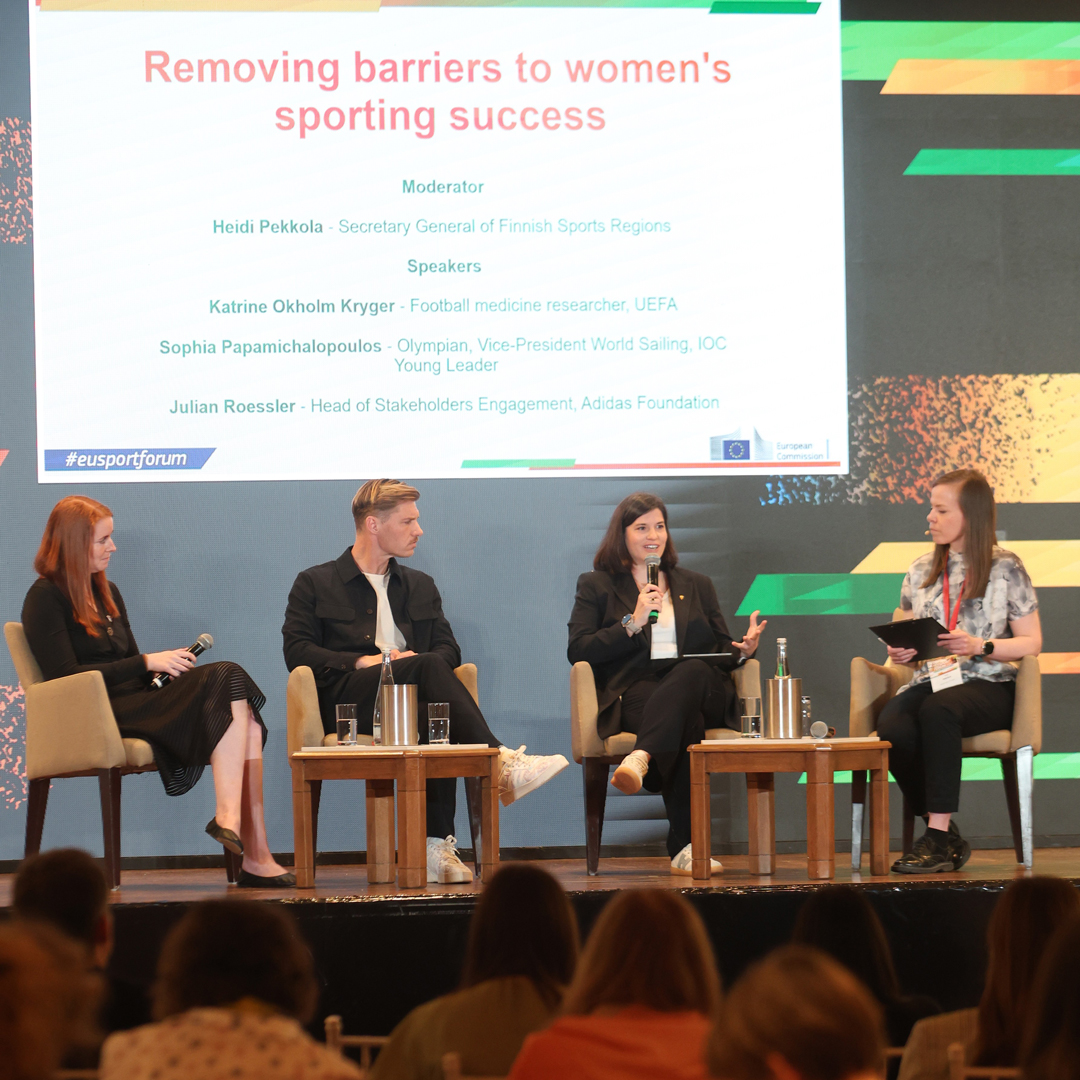
As part of the EU Sport Forum 2026, held in Paphos on April 15–16, the European sporting community came together to discuss the future of sport. Among the voices shaping the conversation was Dr. Sophia Papamichalopoulos, OLY, who returned to her home country to highlight one of the most critical challenges facing modern sport: structural barriers to gender equality.
An Alpine skiing Olympian, general surgeon, and now Vice President of World Sailing, and Commission Member of the International Olympic Committee, Sophia embodies the Olympic ideal through her work in sport, medicine, and society. From her role as Vice President of World Sailing to her award-winning Winds of Change initiative, her journey stands as a powerful example of how excellence can translate into meaningful social impact.
Following the event, we reached out to her for further insights.
Question 1:
At the EU Sport Forum, you spoke about shifting the narrative from a “pipeline problem” to a “structural design flaw.” What is one structural change you believe could immediately create more equal opportunities for women in sport?
I think one of the most impactful structural changes would be to embed female-specific design into the entire sporting system, by default, not as an afterthought.
For decades, sport has been built around the male athlete model, whether that’s training methodologies, equipment design, competition schedules, or even medical research. That creates invisible barriers for women before they even enter the system.
We need to redesign systems so they reflect the realities of female athletes: from investing in female-specific research, to adapting coaching education, to ensuring that equipment and performance environments are actually designed for women’s bodies.
Once the system is designed inclusively from the start, opportunities become naturally more equal.
Question 2
How can smaller countries like Cyprus play a meaningful role in shaping the future of gender equality in sport?
Smaller countries actually have a unique advantage, in that they can move faster and be more agile in implementing change.
In Cyprus, for example, the sporting ecosystem is more compact, which means stronger communication and collaboration between federations, government, and local communities is possible. That creates an opportunity to pilot innovative approaches, whether it’s grassroots programmes for girls, leadership pathways for women, or targeted policy reforms.
And beyond that, smaller countries can lead by example. Impact is not always about scale, it’s about influence. When a country demonstrates that meaningful change is possible with limited resources, it becomes a powerful model for others.
Question 3
Congratulations on your election as Vice President of World Sailing. What concrete actions is World Sailing taking to remove barriers for women and ensure equal opportunities both on and off the water?
As the global governing body of our sport, I believe that it is paramount that we not only to set standards, but to actively drive change across the entire sailing ecosystem.
At World Sailing, this starts with governance. Through recent reforms, we have achieved gender balance at Board level, which is a critical foundation. Because representation at the top directly influences priorities, decision-making, and ultimately the direction of the sport.
But we also recognise that progress in gender equality does not happen organically. It is the result of a long cultural shift, driven by policy, by quota systems, by the intentional inclusion, and by intentional reforms.
Governance alone is not enough, so we are equally focused on pathways. One of the key findings from the World Sailing Trust «Women in Sailing Strategic Review» in 2019 was that many girls enter the sport, but far fewer stay and progress. So our strategy is built around ensuring that a young woman in sailing has a clear pathway of opportunities that can span a lifetime, whether as an athlete, coach, official, or leader.
Concretely, this includes investing in the development of female coaches and race officials, and expanding programmes like Steering the Course, our global festival that promotes grassroots participation and introduces more women and girls to sailing.
We are also working on improving the daily training environment through education. By integrating athlete-centred coaching into all our technical courses, we aim to ensure that coaches, both men and women, better understand and respond to the specific needs of female athletes.
Another important step is the development of maternity guidelines, which is about recognising that motherhood should not be a barrier to continuing a sporting career.
And finally, we place strong emphasis on visibility and representation, whether that’s equal representation in our communications and social media channels, or supporting our member national federations in achieving more balanced participation at all levels.
For me, meaningful change comes from combining leadership, structure, and accountability. And as an International Federation, our role is to ensure that this change is not isolated, but truly global and sustainable.